How to stop a sensitive or illegal trail from being added?
In the local Vancouver area, there is some debate whether trails should be labeled as 'illegal' or 'unsanctioned'. While there are valid arguments behind not supporting 'unsanctioned' trails, many trails around the world can exist in a grey area. Different regions have varying policies towards sensitive or unsanctioned trails. As a result, Trailforks doesn't enforce a standard on these types of trails. Instead, each local trail association can decide on what information for these trails can remain online.
At Trailforks, we do offer varying levels of visibility and warnings, which offers more control than a binary visible/not-visible system.
A trail association may choose to depublish all or certain grey-area trails online, but given the nature of Trailforks as a crowdsourced platform, other users may add one of these trails in the future, not knowing that the trail shouldn't be marked as public. For this reason, Trailforks offers a range of features to help prevent and monitor for unsanctioned trails, if a region so wishes.
Subscribe to a Region
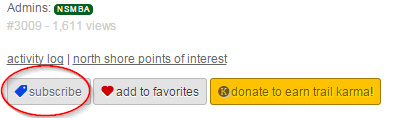
To monitor a certain region, the simplest step you can take is to "subscribe" to the region. You can choose to get an email notification whenever a new trail is added in that region so that you don't have to manually check Trailforks.com for added trails.
Understand Trail Visibility
Trails can be marked with different levels of visibility:
- A trail can be visible (fully public).
- A trail can be visible with a red warning that it is 'Unsanctioned', 'Not maintained,' or to 'Ride at own risk.'
- A trail can be visible with a red restricted access warning: this may mean that a special permit is required to access the trail.
- A trail can be visible, but marked as 'Closed' and 'Do not ride.'
- A trails location can be hidden from the map, but its name is still visible in lists for users to add photos and reports to the trail details page.
- A trail can be hidden (location and name) and only visible to regional admins that have the "hidden" permission.
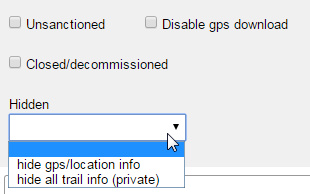
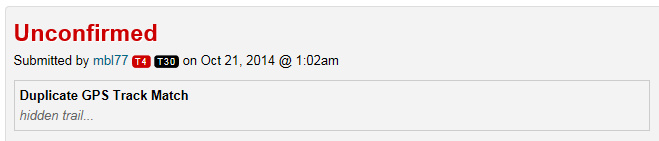
Unsanctioned trails can be added to Trailforks and marked as "hidden," so that only region administrators with "view hidden trails" permission can see those trails. When a user adds a trail where the GPS track closely matches a trail in the database that is marked as "hidden," that user will get a big red warning:

Users can still submit the trail to be added at this point if they wish, but the addition will still need to be approved by a moderator, and the trail will be flagged, so the moderator will most likely reject the trail addition.

OTHER BENEFITS TO MAPPING ILLEGAL TRAILS
Adding illegal trails and marking them as 'hidden' also allows for us to detect users' ridelogs along any "hidden/secret" trails and flag that ridelog as "sensitive." The hidden trails won't be shown in the list of trails ridden; instead, the ridelog map will be hidden, and a warning message will be displayed for that ridelog.

Another important reason to map illegal trails and have ridelogs that include flagged trails is that those ridelogs will no longer be suggested to users in the Trailforks app when a user views another trail's rides. Trailforks also has a feature where the most popular routes in a region are determined based on users' ridelog data. Ridelogs that are flagged as sensitive because they matched to a hidden trail will not be included in the recommended route algorithm.
Mapping hidden trails also allows us to block out the areas around them from our heat-map feature.
We also have a black-out zone feature, where the polygon of a hidden region can be totally excluded from our heat-map.
And finally, having a hidden trail mapped still allows ride usage data to be collected for it, which could effect advocacy decisions for trail associations.